
Hey everyone,
As we step into 2026, we wanted to take a moment to look back on the past year of Alkemion Studio.
2025 was a busy year for the project. Not in a loud or flashy way, but in a steady and deliberate one. Feature by feature, release by release, Alkemion Studio grew into something more capable, more flexible, and closer to what we originally hoped it could become.
It remains a passion project built by a father and a son. We do not claim to have all the answers about what the perfect tool should be. What we do have is curiosity, constant conversations with users, and a strong desire to build something that helps people think, explore ideas, and enjoy preparing their games.
This post is a look back at what was added in 2025, the ideas that guided those decisions, and a brief look at what comes next.
As always, thank you for being part of this journey.
A year of steady growth
One of the early milestones was improving how modules are handled and shared. Being able to duplicate modules, including shared ones, made experimentation safer and removed a lot of friction. It also laid the groundwork for future ideas like version history and long-term projects. Alongside that, the lobby evolved with sorting options, folders, direct renaming, and clearer navigation, making it easier to manage growing collections of campaigns and worlds.
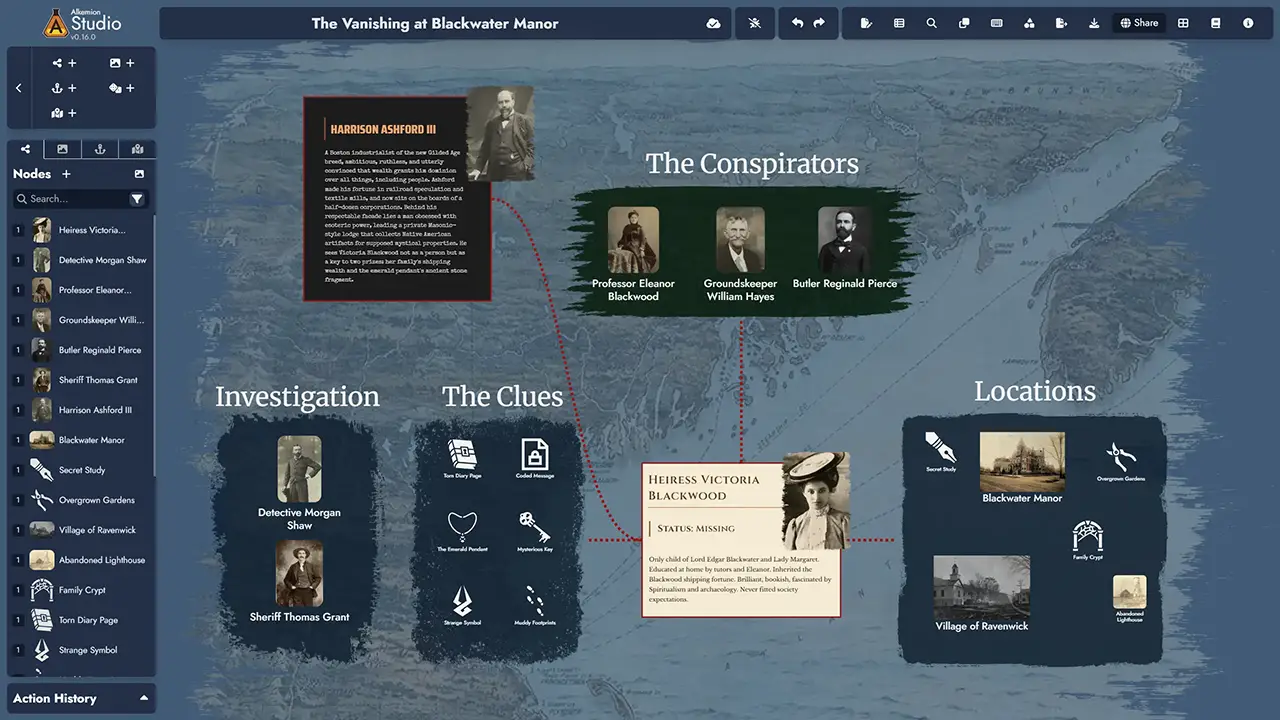
We also redesigned how nodes connect to each other. Links were separated from their visual representation on the board and became a first-class concept. This allowed multiple links between the same elements, better customization, directions, labels, and clearer control over how relationships are shown. It became easier to express nuance, whether that meant cause and effect, secrets, dependencies, narrative flow, or loose associations.
Customization and readability were another major focus. New token layouts, especially card-based layouts, made it possible to bring more content directly onto the board when it made sense. Visual themes expanded the range of moods and genres for written content, while token customization grew steadily with control over colors, borders, opacity, icons, tags, and masks. These changes were about letting users shape their boards to match how they think, whether that meant dense clusters of ideas, high-level overviews, or something in between.
The editor also saw major improvements. Pages were introduced, allowing content to be split into multiple documents instead of living in a single long flow. Standalone text blocks made writing more flexible, letting you add content without everything needing to be a node. Mentions, links, and navigation between the editor and the board were refined to keep writing and visual exploration closely connected.
Another important addition was the Node Table. Some people think visually, others think in lists. The table provided a more data-oriented way to browse, filter, and manage nodes, tags, links, and random tables, while still working with the same underlying content.
Throughout the year, many smaller improvements quietly removed friction. Shortcuts became more consistent, mobile behavior improved, visual cues became clearer, and the theming system was rebuilt to allow much deeper customization in the future. Random tables also became more powerful and easier to use, with weighted entries, text imports, clearer displays, and tighter integration with nodes.
Toward the end of the year, interactive maps arrived as a major new feature. They brought geography and points of interest into modules in a way that supported exploration and movement, without turning the board into a static diagram.
Across all of this, a clear theme ran through the year: giving users more control, more ways to understand their ideas, and more freedom to change direction without breaking their work.
A clearer direction going forward
As the feature set grew, the design philosophy behind the roadmap became clearer as well.
Alkemion Studio is not meant to tell you how an adventure, a campaign, or a world should be structured. The board exists as a place to explore ideas, test relationships, rearrange concepts, and rethink decisions. The editor exists as a place to consolidate, refine, and prepare content for use or export. That loop sits at the center of the tool.
This means favoring user-defined structure over system-defined structure. Defaults can help you get started, but they should never turn into hidden rules. Different game masters should be able to solve the same problem in different ways, without friction.
That philosophy directly shapes what comes next.
Short-term changes, long-term intent
The next release takes an important step in that direction.
Predefined node types have been useful, especially early on, but they also imply a specific model of how content should be organized. Going forward, nodes will no longer be limited to fixed types. You will be able to create nodes without a type, or define your own custom types. At first, this will focus on visual identity through icons or images, with more options opening up over time.
At the same time, Group Nodes will be retired and replaced by Group Widgets. This change separates responsibilities more clearly. Nodes carry meaning and content. Widgets handle layout, grouping, emphasis, and visual structure. Keeping those roles distinct makes boards easier to read and easier to change as ideas evolve.
These changes aim to make the structure you see on the board reflect how you actually think, rather than how the system expects you to think.
Looking ahead to a bigger step
2026 will also be the year of a major leap forward with Alkemion Studio Desktop.
The upcoming crowdfunding campaign will introduce a local, offline-capable desktop application built on everything the web version already offers, while unlocking new possibilities for large campaigns, long-term projects, and power users. Local data ownership, multiple boards per module, cross-module synchronization, version history, and deeper integration with tools like Obsidian are all part of that vision.
As with the web app, the goal is not to turn Alkemion into a rigid database or a fixed wiki. The goal is to provide a space where messy ideas can become clear, where restructuring feels safe, and where the tool stays out of the way of your thinking.
Thank you for being part of it
None of this happens in isolation. Every release in 2025 was shaped by feedback, shared modules, conversations, and the many different ways people use the tool in practice.
A lot has been added. Much more is coming. Most importantly, there is a consistent direction guiding it all.
Thank you for building worlds with Alkemion Studio. We are excited to see where 2026 takes us.
Leave a Reply